A report on the Ball 2023 project exploring the ways pedagogy in football can be mobilized to engender sustainability, climate change, gender equality and fair play.
Background

In 2023, Spirit of Football launched their ‘The Ball’ campiagn to bring awareness to and promote to promote gender equality alongside climate action with the aim of being able to contribute to reduced inequalities in the world of football and beyond.
The campaign goal was simply yet ambitious: implement resources developed in 2022 in a climate friendly (where possible) education journey kick a football to the FIFA Women’s World Cup in Australia and New Zealand from the UK.
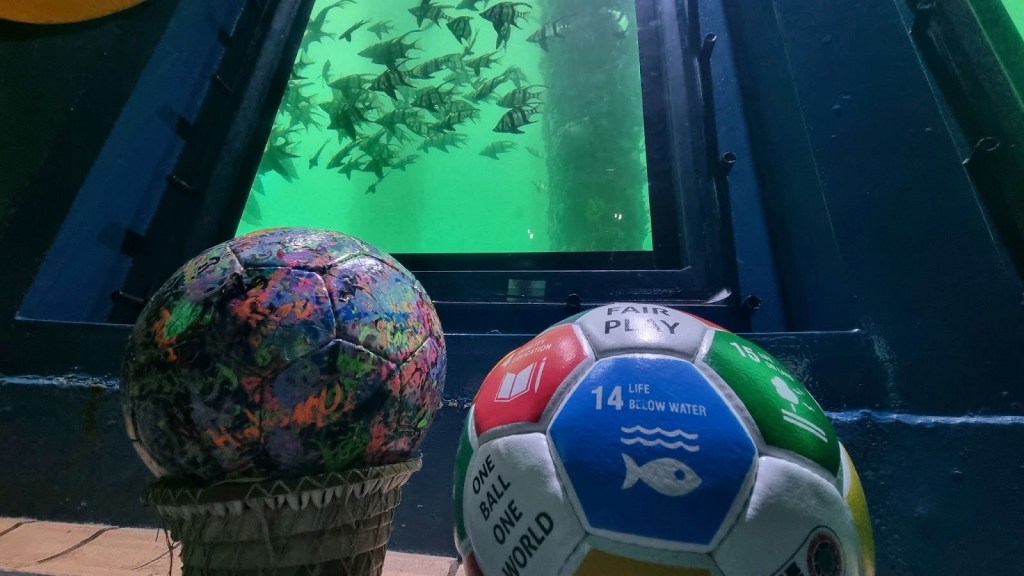
Summary
The One Ball, One World – The Ball 2023 Workshops Report explores how football can serve as a powerful platform for delivering climate change and sustainability education, using the Sport for Development (SfD) model. The report argues that football’s global popularity and emotional resonance make it uniquely positioned to promote climate action, gender equality, and fair play through values-based education. Drawing on qualitative data from 134 participant questionnaires across 11 countries, the report analyzes how Spirit of Football’s workshops—centered around the One Ball, One World handbook—fostered grassroots engagement with sustainability. Participants made personal pledges, often focused on reducing consumption and sharing knowledge with family and community members, reflecting a strong ethics of care and readiness for behavioral change. While some responses revealed vague understandings of sustainability, others embraced stewardship and intergenerational responsibility. The workshops also revealed persistent gender inequalities in sport, particularly football’s perception as a male domain, yet demonstrated that exposure to female role models and inclusive training can begin to shift cultural norms. Fair play was understood by participants as encompassing inclusion, equity, and respect, though it was less central than climate action or gender equality in participants’ priorities. Overall, the report emphasizes the potential of SfD to spark both individual and collective transformation and recommends adapting future workshops to local contexts, building in long-term monitoring and evaluation, and partnering with local organizations to sustain impact.
Actionable Recommendations
- Gain an understanding of local cultural context, values, and knowledge in order to better tailor workshops.
- Pre-questionnaires, interviews, and focus groups delivered in communities before workshops to establish baseline of local knowledge.
- Pre-questionnaires, interviews, and focus groups delivered in communities before workshops to establish baseline of local knowledge.
- Build into future projects (including grant writing) scope, time, and resources to return to communities and provide follow-up monitoring and evaluation of the ways in which trainers have used and modified the toolkits to local contexts.
- Link with local organizations and universities who have the skills and tools to conduct on-going M&E of TOT participant’s impact.
- Design new tools for collecting information on the impact of workshops, including immediate and longer-term feedback.
Contact me at sean.heath@kuleuven.be for more information about my Consultancy Practice in Sport, Recreation, and Climate Change.
 Sean Heath, Ph.D.